

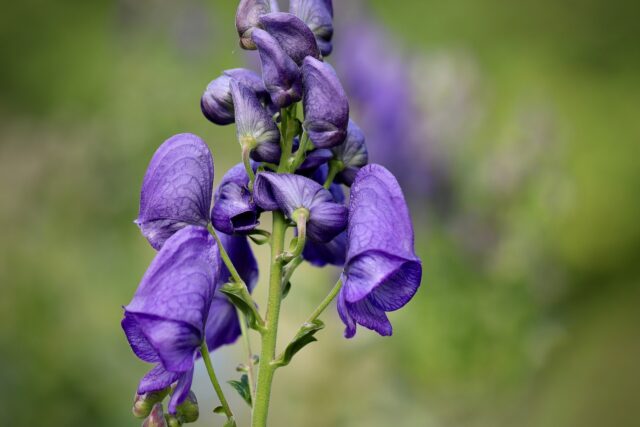
Monkshood is a herbaceous plant that grows in Asia, Europe, and North America. Its fragranceless flowers form characteristic spikes and spots of blue, lilac, pink, and white. The erect stem is almost always simple and can grow over a meter tall. The alternate leaves have a long petiole; the blade is divided into five lobes, which are in turn deeply incised into long, thin segments. The surface is glabrous, with very visible veins on the underside.
Index of topics
ACONITE
The best-known species in Italy is monkshood , a very beautiful plant, but also one of the most toxic plants in our country. It is frequently found in Alpine heights, and if you want to grow it, you must take precautions.
READ ALSO: Snowdrop, the ideal lawn flower
PRECAUTIONS
Aconite should be grown as a border, and the plant's toxicity is contained in its flowers . Therefore, it's best to keep them away from children and anyone unfamiliar with this aspect of aconite. The plant, which can grow up to about a meter tall, produces spike-shaped flowers. It's also important to grow aconite in groups, not in overly accessible flowerbeds.
ACONITE POISON
The poison of aconite is deadly. It's all due to a substance, aconitine, contained in the flowers. Its action is extremely rapid: within 10 to 90 minutes, the aconite flowers produce their devastating effects, from itching to palpitations, even tachycardia and difficulty breathing. Just three grams of aconitine can cause death within a few hours. Furthermore, the effects of contact with aconite on human skin should not be underestimated, from itching to motor problems.
EXPOSURE AND CLIMATE
Aconitums prefer temperate climates. They enjoy light shade, but like many flowers, they can also adapt to full sun. They do not tolerate excessively windy areas.
SOIL AND CULTIVATION CARE
The ideal soil for the aconite genus is moist, humus-rich soil, which should be fertilized periodically with a ternary fertilizer.
IRRIGATION
Keep the soil consistently moist, avoiding overwatering. Watering should be done from early spring throughout the summer, then stopped in the fall and winter.
READ MORE: Aquilegia, the flower that resembles an orchid
SOWING AND FLOWERING
Propagation can be done either by seed or by dividing the clumps, in spring or autumn. Flowering begins in late June.
PROBLEMS AND REMEDIES
Aconite can be attacked by botrytis (a gray mold) and damaged by phytophagous insects. Use specific pesticides as needed.
THREE FLOWERS TO DECORATE YOUR BALCONY WITH:
- Tulips: How to Grow Them on the Balcony and in Pots
- Wisteria: the flower that announces spring
- Lavender: How to Grow It in Pots and on the Balcony
Want to see a selection of our news?
- Sign up to our newsletter clicking here;
- We are also up Google News , activate the star to add us to your favorite sources;
- Follow us on Facebook, Instagram e Pinterest.