
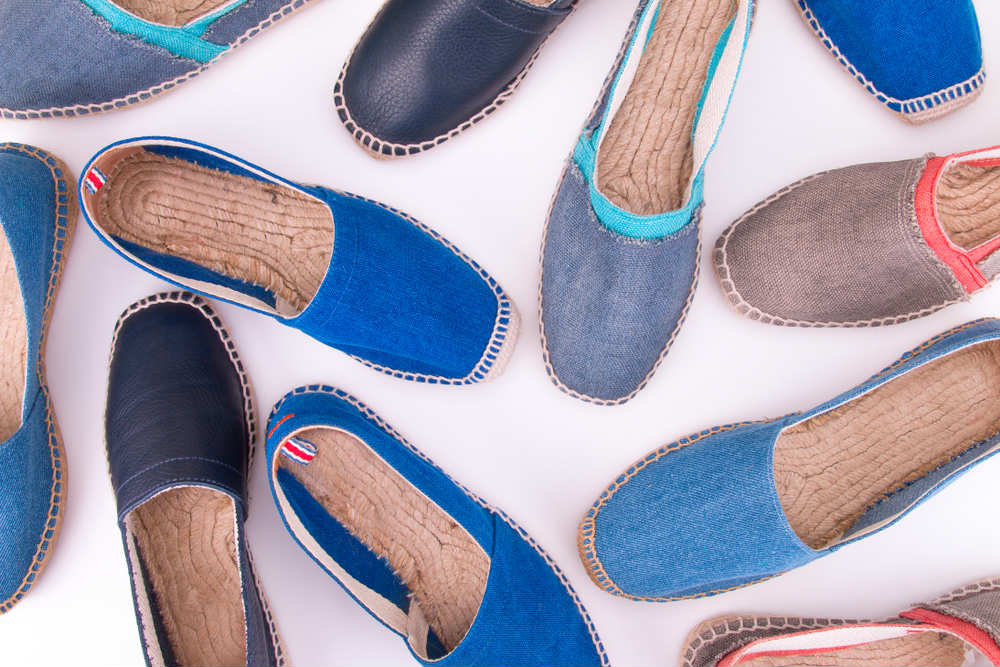
Espadrilles are rightly considered the ideal shoe for hot weather and throughout the summer months. First of all, they're lightweight (with jute or rope soles that make walking less tiring) and allow the foot to breathe because the canvas or cotton upper is much more breathable than synthetic leather, rubber, or closed materials. Furthermore, they retain less heat than closed sneakers and shoes with thick rubber soles, and the rope sole, especially in traditional models, moves quite naturally with the foot. The natural fiber sole bends easily, following the foot's movement, offering a more natural feel than shoes with rigid soles. They're not too restrictive: many models have a relatively wide fit and a non-constricting upper, and they're slip-ons, so they can be worn without laces or complicated fastenings.
Precisely because of these qualities, espadrilles have a limitation that should be kept in mind when wearing them: they're not suitable for long walks. Classic espadrilles often lack arch support and cushioning, and even for a walk of a few kilometers, a good breathable sneaker can be significantly more comfortable.
Index of topics
How to wear them
For men
- With linen or cotton shorts and a light shirt.
- With chinos rolled up at the ankle and a polo shirt.
- With linen trousers and a long-sleeved shirt for a summer evening.
- Even with a casual summer dress in linen or cotton, espadrilles have a simple and refined design.
For women
- With light summer dresses and midi skirts.
- With shorts and top in linen or cotton.
- With cropped or wide-leg jeans.
- Wedge espadrilles also pair well with more elegant looks for aperitifs or informal events.
They're usually worn without visible socks . If you prefer a barrier between your foot and your shoe, you can use very low, invisible socks. Keep in mind that espadrilles look best when a little ankle is visible, but avoid wearing them in the rain or on very wet surfaces, as the jute soles can deteriorate.
Origins
Their name derives from the Catalan term "espardenya ," which in turn comes from espart , a Mediterranean plant (esparto) whose fibers were used to make ropes and soles. The earliest forms of espadrilles date back at least to the Middle Ages, and some historians believe similar models existed centuries earlier. The Archaeological Museum of Granada preserves a pair, found during excavations in Cordoba , which date back 4 years.
Traditionally, they were the shoes of farmers, fishermen, and workers in the regions of Catalonia, the Basque Country, and southern France. They were cheap to produce because they were made from local materials:
- sole woven from plant fibres (initially esparto, then often jute);
- upper in cotton or linen canvas.
The various models
There are at least five models of espadrilles.
- Le espadrilles classical They have a low sole and are perfect for going to the beach or on a day trip without worries. Lightweight and comfortable, espadrilles are even better than beach slippers or flip-flops. thongs.
- Le wedge espadrilles They're also ideal for the evening and a great alternative to high-heeled sandals. You can wear them for a romantic evening with your partner or perhaps for a first date. You can pair them with slip dresses or long dresses. To be taller, as an alternative to wedges, you can choose espadrilles with Portal, which makes the entire sole higher and not just the toe.
- Le lace espadrilles They are elegant and suitable for all ages. You can wear them at the beach or in the city. The light lace ones in particular are perfect for daytime or for special occasions where it is essential to feel comfortable and free to walk in the city. park.
- Le ethnic espadrilles di cloth with tribal and folk-themed prints are another great summer classic. An ethnic espadrilles will make alternative and your summer look will be less dull. Plus, the choice of prints is vast, so you can have fun pairing them with your favorite summer dresses.
- Le vegan espadrilles, finally, they are handmade with materials 100 percent natural, obtained without animal suffering. Some are exceptionally long-lasting, others particularly sustainable
, or with specific characteristics, such as lightness or weather resistance, and with a wide variety of designs.
How much do they cost?
Espadrilles today cover a very wide price range, depending on materials, brand, and finish.
| Head Band | Typical price |
|---|---|
| Economical (large-scale distribution, fast fashion) | €15–30 |
| Mid-range | €30–80 |
| Premium brands | €80–150 |
| Luxury | over 200 € |
When you can't wear them
Espadrilles can be worn for most casual occasions during the warmer months, and are perfect for city strolls, beach vacations, happy hours, summer weekends, and many casual or smart-casual occasions. However, there are some situations where they are less suitable:
- With rain or wet ground: The typical jute rope sole absorbs moisture and can quickly deteriorate.
- In winter or in cold temperatures: in addition to offering little protection from the cold, they appear out of place compared to seasonal clothing.
- For activities that require a lot of walking or sports: they generally do not offer the support and cushioning of a technical shoe.
- In very formal environmentsElegant weddings, gala events, particularly formal business meetings or contexts with a strict dress code usually require more elegant footwear.
- In workplaces with safety requirements: Construction sites, laboratories, warehouses and similar environments require adequate protective footwear.
Read also:
Want to see a selection of our news?
- Sign up to our newsletter clicking here;
- We are also up Google News , activate the star to add us to your favorite sources;
- Follow us on Facebook, Instagram e Pinterest.