
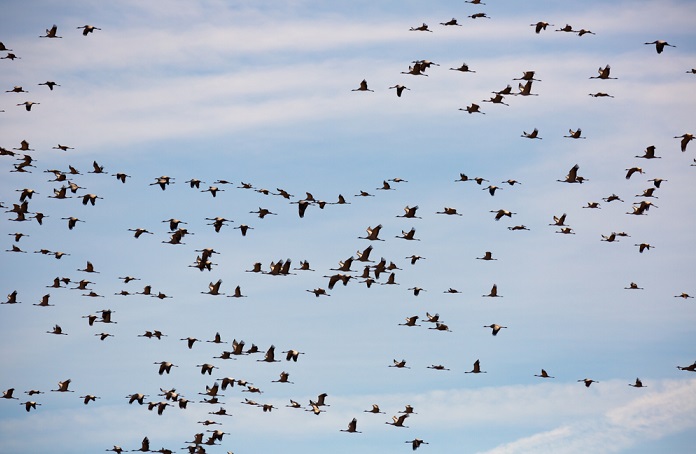
They seek food, temperatures more suited to their characteristics, and they need to nest. These are the fundamental reasons why birds give us the magic of migration , which we should not waste with our gaze. They usually travel at an altitude of 600 meters, but can reach up to 8 meters , crossing paths with airliners. Their average speed is around 80 kilometers per hour , and migratory birds can travel up to 3 kilometers in a day.
Bird migration is one of the most fascinating and exciting spectacles for true nature lovers. In theory, there are two seasons: spring and autumn; in reality, bird migration is perennial, lasting 365 days a year. The actual migration period depends on several factors, such as the species, migration distance, speed of movement, route, climate changes, and food availability.
Index of topics
When do they migrate?
How to follow bird migration
To follow the migration, and experience the same thrills as birdwatchers , it's essential to know a few things about migration. When it's time to move, birds are quite fattened, and you might even struggle to recognize them. The reason is obvious: nature provides them with a reserve, stored in their bodies, to withstand the strain of the long journey. Long, yes, but how long? It depends. It ranges from a week to much longer periods, even four months. And not all birds migrate at the same times, a diversity that makes the spectacle visible 24 hours a day. Hawks and swallows, for example, migrate during the day, while larks move at night.

What are migratory birds?
But where do the most important birds come from and where do they go? We've selected ten, and for each we've identified the entire flight path, which you can follow with your binoculars.
-
Swallows
They are among the most widespread birds in Italy and can be seen almost everywhere. The migration route is the classic Tyrrhenian one, which runs from the northern regions through Tuscany, Lazio, and Campania. It then descends toward the southern nations, from Nigeria to the Central African Republic, all the way to the savannas of the Sahel. Here the swallows winter, then retrace their outward journey and return to our area in the spring.
-
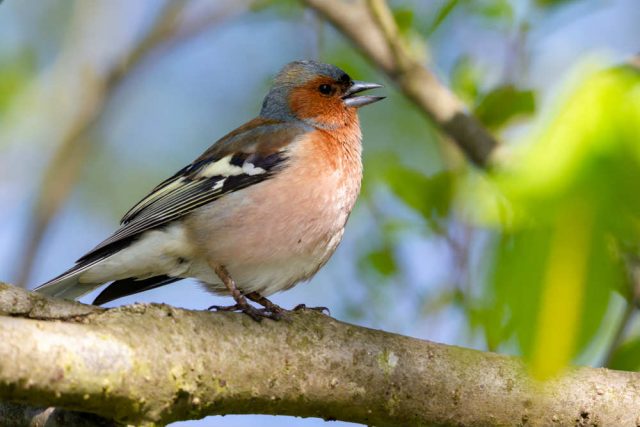
Finches
Theirs is a coastal route. We also have many of them in Italy, but they are concentrated in central Europe. From there, in autumn , they migrate to the warmer coasts of Spain and France, also crossing our Po Valley. They are solid and hardy birds, despite their small appearance, and therefore they don't need to travel very far to spend the winter.
-
Falchi
They are a protected and migratory species of birds of prey, present in Europe only in summer. Over the years, the most frequently observed species have been the Black Kite, the Marsh Harrier, and the Honey Buzzard, which, with over 200.000 individuals, is the most numerous species during the pre-nuptial migration along the islands of the Sicilian Channel.
-
Black Flycatchers
They are present in Italy as transient birds and occasionally nest in the northern regions. Their habitat consists of both broadleaf and coniferous forests with abundant undergrowth, as well as parks and gardens . During migration, they also frequent olive groves, poplar groves, and tree-lined edges of wetlands.
-
Storks
In Europe, there are 220,000 pairs, while in Italy, where they returned to nest in the 1980s after a long absence, the species has now exceeded 200 pairs. The white stork spends the winter in tropical Africa, migrates in spring along the Bosphorus and Gibraltar Straits, and in smaller but still significant numbers along the Strait of Messina. It breeds in Europe, especially in eastern regions.
-
Robin
It belongs to a forest species that nests in our woods in Piedmont and Sardinia . With the arrival of cold weather, the robin emerges from the dense forest, where it has raised its young, to venture into the countryside, into vegetable gardens, orchards, olive groves, and parks. During this time, it becomes visible and even more confident around humans, so much so that it approaches within a few meters of them, following them step by step as they prepare the soil and unearth worms and other insects that the robin is notoriously fond of.
-
House Martin
It belongs to the same family as the swallow, has black and white plumage, and is distinguished by its short tail. It breeds throughout Europe, much of Asia, and the Maghreb. These migratory birds remain in these regions from April to September. European house martins winter in Africa, Southeast Asia, and, to a small extent, on the Arabian Peninsula along the Red Sea.
-
Cormorant
It is a gregarious and "cosmopolitan" species that inhabits virtually every continent (Europe, Asia, Africa, Oceania). Many individuals spend the winter in Italy, then migrate to the Southern Hemisphere in spring to breed, or to Scandinavia and Central Europe. Other cormorants are sedentary and breed in favorable areas, such as the Po Delta and Sardinia. Finally, a significant flock passes through the peninsula during the continental European migration, in March and October.
-
Duck
They arrive from the north in autumn and prepare to depart after wintering in the most welcoming and mild wetlands of our country, namely the quieter valleys of the Po Delta, but also in the ponds around Cagliari. In winter, large flocks of ducks can be seen: a small number remain in Italy to nest during the warmer months.
-
Heron
It is a partially sedentary and nesting species. In Italy, herons are mostly found in the north, along the rivers of the Po Valley, where many of their colonies are concentrated, but also among the rice paddies of Piedmont and Lombardy. Many individuals can be spotted in Tuscany, along the banks of the Arno and Serchio rivers. They can also be observed in the upper Velino Valley and on the banks of the Tiber and its tributaries.
Bird Migration Calendar
On this page , you'll find the migration periods , from August until late autumn, for each bird species. As for the exact times, everything depends on the bird species. Swallows, hawks, and storks, for example, fly during the day and rest at night before continuing their journey the next day. Larks, on the other hand, are among the birds that prefer to travel exclusively at night, primarily to avoid predators that always lurk along their route.
How birds orient themselves during migration
To orient themselves during migration, birds use three types of orientation: magnetic , geographic , and astronomical . The first type relies on chemical sensors on the birds' bodies and beaks, which function as a natural GPS. Thanks to these sensors, birds never lose their way during their journey. Geographic orientation, on the other hand, is the product of habit. By constantly following the same route, migratory birds are able to proceed automatically, orienting themselves by looking at coastlines, rivers, and mountains. As for astronomical orientation, in this case the compass is provided by the constellations of stars and the position of the sun . Not to be underestimated is the teaching of orientation that, in migratory birds, is passed down from generation to generation, while at the head of each flock there is always a group of birds considered more expert and better able to understand the route and potential dangers.
How long does the migration last?
Read also:
- Amalfi Coast: 400 kg of endangered coral stolen in two years
- Bird feeder: How to make one by recycling a plastic bottle (photo)
- Vultures return to Italy, protected areas and repopulation initiatives increase
Want to see a selection of our news?
- Sign up to our newsletter clicking here;
- We are also up Google News , activate the star to add us to your favorite sources;
- Follow us on Facebook, Instagram e Pinterest.