
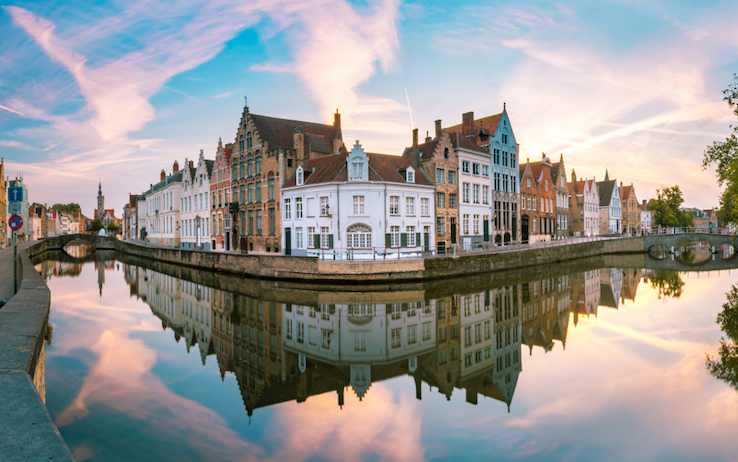
Fewer tourists but more attention to the beauty and life of the city. Bruges , the splendid capital of West Flanders, has decided to curb uncontrolled tourism . Literally overrun in recent years, with enormous damage to the daily lives of residents and the maintenance of its monuments, the Belgian city has adopted a new strategy aimed at limiting excessive access to the historic center, especially for one-night visitors (those staying no longer than two hours), to promote more sustainable and quality tourism. To achieve this, it has reduced the number of cruise ships allowed to dock at the nearby port, cut investment in tourism promotion, and halted the construction of new hotels. This strategy, adopted by the administration led by Mayor Dirk De Fauw, aims to avoid the Disneyland model for its splendid medieval city.
BRUGES GRANDI NAVI VENICE
This same result should be pursued with greater conviction in our country too, where, after yet another accident, the Minister of Infrastructure, Danilo Toninelli, has finally announced that a solution will be found by the end of June to move large ships away from Giudecca and San Marco in Venice.

READ ALSO: Florence, Venice, Rome: They're not free beaches. But they're art cities that tourists can't ruin.
These measures inevitably encounter highly influential interests. Consider that large ships in Venice are a €280 million business , bringing over 31 million passengers to the lagoon city between 1997 and 2018 , with all the problems one can easily imagine. The invasion has also hit Bruges: the city known worldwide for its canals, cobblestone streets, and medieval buildings welcomed over 8 million tourists this year, an increase of approximately 900 people compared to the previous 12 months. Of these, however, the vast majority stay in the city for no more than three hours, thanks to cruise ship transfers and day trips organized by tour operators.
BRUGES TOURISM RESTRICTIONS
To curb this very trend, the administration has reduced the number of cruise ships that can dock at the same time in the port of Zeebrugge to two. Previously, there were five. Furthermore, a policy has been adopted to encourage large shipowners to schedule visits on weekdays rather than weekends, when tourist numbers increase exponentially. Another aspect of the strategy, as Amsterdam in the Netherlands has already done, is to drastically cut funding for tourism promotion : the city is already well-known enough that there is no need to further incentivize tourism. Finally, the construction of new hotels has been banned , and restrictions have been placed on residents who wish to rent out their homes. Finally, to preserve the city's characteristic shops, the federal government is attempting to limit souvenir and theme shops.
MASS TOURISM
At certain times of the year, the number of visitors to Bruges can double or triple that of residents in the historic center, making the situation truly unsustainable . Therefore, restrictions are necessary, and, contrary to what one might imagine, they will not have negative economic consequences; on the contrary, the goal is to promote quality tourism that encourages visitors to spend more days in the city, fully experiencing its atmosphere, thanks also to its numerous museums and characteristic restaurants.
WHEN TOURISM IS A VALUE:
- Cycling holidays: a short guide to cycle tourism. From the crew to the route.
- Silence, please: this is how Finland promotes tourism. And it reminds us of the health risks of excessive noise.
- Traveling on foot in Italy and Europe: the most evocative itineraries
- Women on bikes: A Giro d'Italia begins to remember the only woman who challenged men.
Want to see a selection of our news?
- Sign up to our newsletter clicking here;
- We are also up Google News , activate the star to add us to your favorite sources;
- Follow us on Facebook, Instagram e Pinterest.