
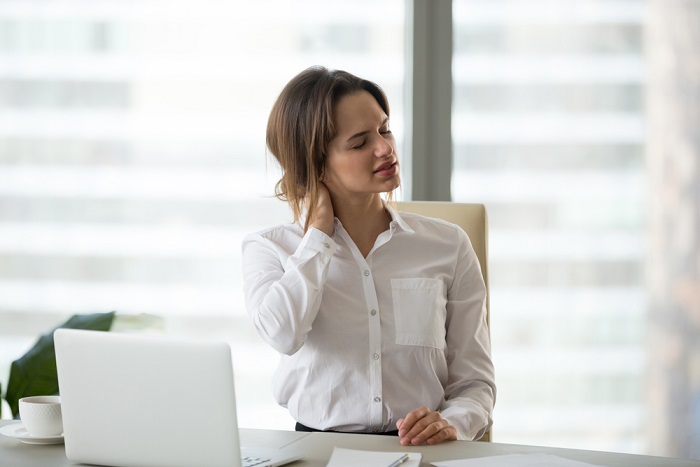
Those who have neck pain often worry that "something is broken." It's as if they've suffered an injury or a hernia. Nothing could be more wrong: the stiff neck It's not related to any structural damage to our body, but simply to a problem, fortunately temporary. Therefore, there's no need to waste money on immediate purchases of medications.
Index of topics
What
Torticollis is a functional disorder that causes sharp, intense neck pain. The lateral neck muscles contract, limiting or even completely eliminating neck mobility. This pseudo-pathology can last from a few days to a couple of weeks, after which the pain subsides, only to recur—a true relapse—when the same causes that caused it previously persist.
Symptoms
Stiff neck presents with very specific symptoms. The most common are the following: first, the inability to turn or extend the neck without causing localized, intense pain. Second, the stiff neck radiates down the arm (in this case, the functional impairment is more pronounced). Finally, the neck muscles are effectively out of function.
Cause
Stiff neck has three causes, two more common and one rather rare. First, there's the problem of muscle contractures that can result from incorrect positions (especially during sleep), temperature changes, and excessively abrupt and sudden movements of the neck. In these cases, stiff neck usually lasts a short time, a few days at most, and therefore there's no need to resort to treatment. drugsNatural remedies are more than enough. Then there's the source of the disc disease: disc pain can progress to the point of causing a herniated cervical disc. In this case, the pain lasts longer, even several weeks, so it's best to consult the same doctor who treated your herniated disc. Finally, but here we're dealing with rare cases, stiff neck is the consequence of rheumatic diseases such as spondylitis. The pain appears at night, is more intense in the morning, and swells with inactivity: it can last for several months.
Remedies
Now that the causes of stiff neck are clear, let's look at simple and effective remedies.
- Start with the ice and heat of a shower. An ice pack or a small amount of ice wrapped in a cloth is a good solution when the stiffness has just begun. If the neck is mild, ice helps reduce swelling. After the ice has reduced any inflammation, heat is a wonderful sedative, whether from an electric heating pad or a hot or warm shower. It provides an effective, very gentle massage.
- Give yourself a massage. The rubefacient ointments (The ones that heat) provide relief, but they don't have a real healing effect because they don't penetrate the skin's surface. Never use them with heating pads. At most, they offer a psychological benefit.
- No immobility. Say no to laziness using a stiff neck as an excuse. Try to maintain your lifestyle and exercise habits as much as possible. Immobility makes the situation worse, or at best, doesn't improve it.
Contrary to popular belief, it's not recommended to try not to move your neck, as this only promotes joint stiffness. Instead, it's best to make gentle movements to relax your muscles, avoiding straining your neck.
- The classic aspirin. Anti-inflammatories such as aspirin or ibuprofen help reduce pain and inflammation. Take 500 milligrams of aspirin or 200 milligrams of ibuprofen 3-4 times a day, preferably on a full stomach and provided that there are no contraindications.
- Hot compressesThey produce immediate relief by reducing, if not eliminating, pain. They are particularly effective when the stiff neck is caused by a contracture in the cervical muscles.
- If you have a sedentary jobWith your head glued to the computer, get into the habit of frequently breaking this postural habit. Stand up, walk around, and move your neck: at least every half hour. This will naturally keep your joints lubricated.
-
Massages and manipulations They are certainly useful, but they must be done by expert hands.
-
In the acute phase You can try taking an anti-inflammatory, while ointments, patches and over-the-counter products are quite useless.

How to quickly reduce neck nerve inflammation
How long does it take for a stiff neck to go away?
Cure
- The kinesio tape. If your stiff neck is caused by a muscle contracture, colored kinesio tape patches can help. Apply them along the length of the muscle, and you should quickly experience anti-inflammatory and pain-relieving benefits.
- Choose a solid seat. Your back is connected to your neck, and if you're sitting in a chair that doesn't support your back well, you're more likely to worsen an existing stiff neck and cause more. When you sit, roll up a towel and place it behind your lower back. This will keep your spine more upright and provide additional support.
- Take a break. Your feet need rest if you're always standing, and your neck needs rest if you're always sitting. Your head weighs about four kilos A heavy burden to carry around your neck, without much help from the rest of your body. So get up and take a walk every now and then.
- Keep your chin tucked inHold your head up and tuck your chin in, as if you're having a double chin. Also, avoid keeping your head down all the time when working at a desk or reading. This will help prevent straining the neck muscles.
- Adjust the screen to the right height. If you work all day at a computer screen, it's important to position it at eye level. Constantly straining to look up or down can cause neck spasms.
- Telephone troubles. If you talk a lot on the phone, especially while sitting down to type, you keep your neck in an uncomfortable position: an invitation to stiffness and pain.
- Lift weights with caution. It's easy to forget that there's a right way and a wrong way to lift heavy objects. The right way is to bend your knees and keep your spine straight as you place the object between your feet, which should be shoulder-width apart. When lifting, keep the weight as close to your body as possible.
- Sleep on a firm mattress and with a firm pillow. Many neck problems begin and worsen when you habitually sleep in an incorrect position. mattress Without hollows, it's important. Like a firm pillow, not a very soft one, or a cervical pillow. In any case, don't sleep on your stomach: it's bad for your back and neck. Prefer the fetal position, with the knees bent towards the chest.
- Cover your neck well. When it's cold and wet outside, you probably wear a hat, but you should also cover your neck. Bad weather can aggravate neck stiffness and pain. The same goes forconditioned air: better to cover the neck.
- Relax. The simple fact that you're tense tightens your neck muscles and causes pain. If you're under pressure or feel very tense, learning some relaxation techniques, such as meditation or gradual relaxation.
Medicines
- Ibuprofen
- Diclofenac
- Piroxicam
Prevention
Due to its characteristics and the origins of the disorder (poor posture, excessively rigid positions, insufficient rest, stress and anxiety, etc.), stiff neck can be easily prevented with a few simple precautions. Here are the most important ones.
- Get used to correct posture, not only when you work, but also when you sit at the table or on the sofa.
- Try not to sleep in a prone position, and prefer the fetal one, with the knees bent towards the chest.
- Avoid excessive movements, violent, and snapping of the neck.
- If you have a natural predisposition to neck pain or stiff neck, avoid carrying heavy loads.
- Don't get affected by temperature changes which produce air currents that are harmful to the neck.
- Oxygenate your muscles with a couple of exercise sessions a week, lasting about 40 minutes each. Make sure to combine these exercises with aerobic work, stretching, and muscle relaxation.
Exercises to help the neck
- Stretching exercises for contracted muscles.
- While sitting, tilt your head to the side and, with the hand on the same side, gently try to bring your ear toward your lowered shoulder. Count to 30 and repeat on the other side.
- Tilt your head to the side, guiding it with your hands, looking up at the armpit on the same side. Count to 30 and repeat on the other side.
- Standing with your hands behind your neck, push your chest out and your stomach in. Don't move your shoulders, and perform the exercise several times throughout the day. Even while sitting.
- Yoga and Pilates are certainly useful exercises to avoid a stiff neck.
How much does the head weigh when it bends forward?
Pharmacological therapy
If the natural remedies we've outlined aren't enough, and even anti-inflammatory and analgesic medications aren't enough, you can consider a simple treatment for a stiff neck. This won't waste your money or your health, and you should consult your doctor. Generally, the most commonly used medications for pharmacological therapy are ibuprofen and cortisone. In more severe cases, your doctor may recommend wearing an orthopedic collar for a certain period of time.
How to eliminate neck tension
- Sit on a chair, feet on the floor, perhaps in front of a mirror, with your head held high.
- Then bring your right arm behind your back, with the back resting on your lower back.
- Tilt your head to the opposite side, gently pushing your head towards your shoulder with your left hand.
- Hold the position for 10 seconds and then return to the starting position.
- Perform the exercise five times, and after a 10-second pause, repeat on the other side.
Read also:
- How to sit to protect your back
- Yoga: Techniques, Benefits, and Contraindications
- How to wear high heels
- Back pain: causes, remedies, and prevention
- Cervical: causes, remedies and prevention
Sign up for our newsletter to stay up-to-date. Click here!
Want to see a selection of our news?
- Sign up to our newsletter clicking here;
- We are also up Google News , activate the star to add us to your favorite sources;
- Follow us on Facebook, Instagram e Pinterest.