
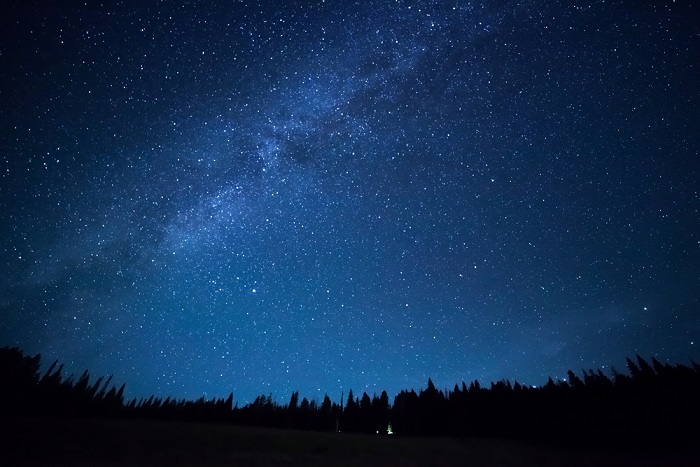
Watching shooting stars means observing meteor showers: tiny fragments of space dust that enter the atmosphere and burn up, creating luminous trails. A unique and always thrilling spectacle. To avoid wasting it, however, a few precautions are essential: the right location (definitely away from cities), the right time (after 22 pm), lying down (the field of view is wider), and with the naked eye (no telescope needed). And, above all, with your smartphone turned off.
Index of topics
When to see them
There are different times of the year when the shooting star show is most beautiful and intense. The most spectacular meteors are undoubtedly the Perseids, best admired between mid-July and late August.
These are the best times of year to admire shooting stars:
| Meteor Shower | Period | Peak | Note |
|---|---|---|---|
| Perseids | 17 July - 24 August | 12-13 August | The most spectacular, visible in summer |
| Leonids | 6 - 30 November | 17-18 November | Rarer but more intense |
| Geminids | 4 - 17 December | 13 14-December | Very abundant in winter |
| Quadrantids | 28 December - 12 January | 3-4 January | Short but intense |
The most suitable environmental conditions
The first thing to do is check the weather forecast and the moon's condition. Clear skies with good weather are certainly preferable for stargazing than cloudy skies, even if only intermittently. As for a full moon, days when it shines are not the best for stargazing . A full moon is the second brightest object in the sky, thus reducing the brightness and visibility of the stars.
The time
The best time is definitely around dawn, assuming the weather is on your side and favorable. So, wake up during the night and don't complain: it's not a wasted effort. Generally, the best time is from 22 pm onwards, with peak times between midnight and 4 am.
With the naked eye
Shooting stars are best admired with the naked eye: no binoculars or telescopes, which limit your field of view. Stop for 15-20 minutes in the dark before starting to watch the show: this will allow your eyes to adjust to the unique experience.
Far from cities and inhabited centers
To best see as many shooting stars as possible, you should move away from inhabited areas, especially cities. Light pollution is the worst enemy of shooting stars and the wishes they entrust to you. Also avoid buildings, mountains, and trees that obstruct your view, and prefer higher altitudes, where clean air and less turbulence improve the visibility of shooting stars.
Turn off your smartphone
While observing shooting stars, simply turn off your smartphone . It only creates disturbance, annoyance, and unnecessary distractions. In this case, technology breaks the spell of silence combined with sight, of an absolutism of the image. Also avoid photos and selfies: if you want to try your hand at photography, it's best to take a dedicated excursion and use a camera suitable for taking this type of image.
It takes patience to watch shooting stars
Don't expect to catch a few shooting stars at first glance: have the necessary patience . And keep in mind that the eye needs time to adjust to these types of images and visions.
Night of San Lorenzo
The night of San Lorenzo, August 10th, is considered the time of maximum visibility for shooting stars, particularly between 10:00 AM and 3:00 PM, when the Earth's orbit around the Sun intercepts the swarm of debris left by Comet Swift Tuttle. In reality, the phenomenon continues into the following days, and the eye should be on the lookout for the Perseids, known as the "tears of San Lorenzo," a periodic meteor shower visible from Earth even to the naked eye.
How to make a wish
A curious fact lies in the tradition of making a wish at the sight of a shooting star. First of all, the etymology of the word "wish" comes from Latin, where "de siderum" means "on the stars." Wishing upon the stars was also a common practice among sailors who, in addition to compasses, oriented themselves by the constellations: at the sight of a shooting star, they expressed the desire to reach their destination on dry land. Furthermore, the role of the shooting star as a guide is also well-known in Christian tradition, where a shooting star showed the Magi the way to the cave with Baby Jesus.
We are all "children of the stars"
Ultimately, we can all consider ourselves "children of the stars," as humans have always consulted stars, meteors, and nebulae to read messages and indications about our lives—past, present, and future. And in ancient times, astrologers' approval was constantly sought for practically everything.
Negative meanings of shooting stars in ancient times
In ancient times, there were also traditions that assigned a negative meaning to shooting stars. In Sparta, for example, the sky was scrutinized, with the utmost attention, every nine years: if a shooting star appeared, considered a harbinger of misfortune, the king was deposed. In ancient Persia, shooting stars were also considered a sign of impending trouble. And for the Chinese, shooting stars
Read also:
Want to see a selection of our news?
- Sign up to our newsletter clicking here;
- We are also up Google News , activate the star to add us to your favorite sources;
- Follow us on Facebook, Instagram e Pinterest.