
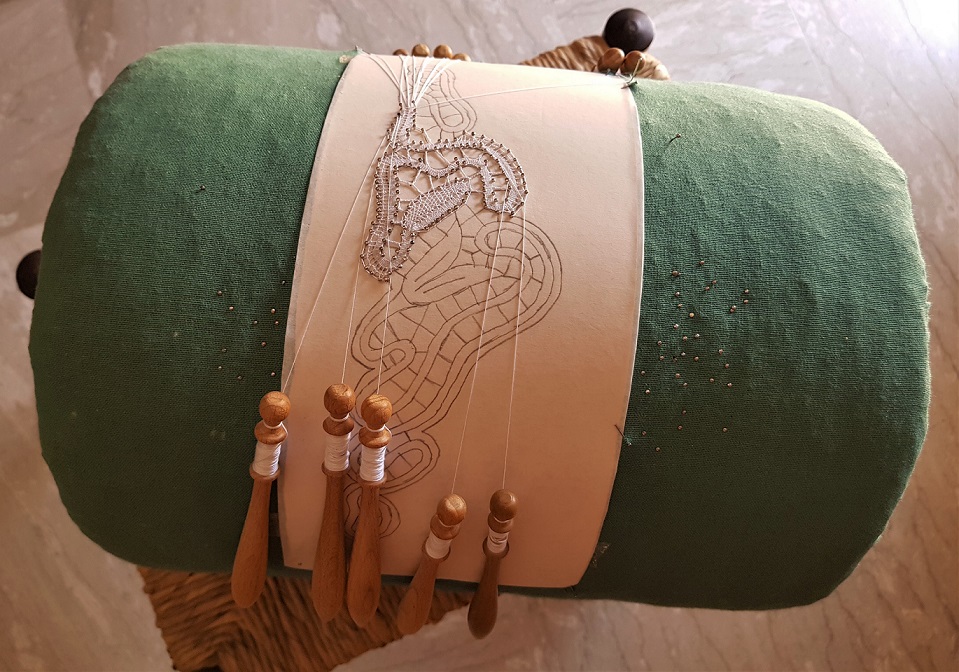
Unique pieces crafted by hand with precision and patience. An art to be jealously guarded. And it is precisely to promote this special tradition worldwide that twenty-seven Italian municipalities, starting with Isernia (plus Varallo, Cuneo, Sampeyre, Cantù, Venice, Chioggia, Gorizia, Chiavari, Rapallo, Portofino, Santa Margherita Ligure, Camogli, L'Aquila, Genoa, Bologna, Meldola, Orvieto, San Feliciano (a hamlet of the municipality of Magione), Offida, Latronico, Bolsena, Maglie, Forlì, Mirabella Imbaccari, Bosa, and the Mountain Union of the Municipalities of Valsesia), have signed a memorandum of understanding to support the candidacy of Italian lace for UNESCO Intangible Cultural Heritage of Humanity.
A noble and refined art: in the past, the precious laces created were used to decorate brides' trousseaus . Today, the tradition of bobbin lace is among the most appreciated, even in the world of haute couture.
Index of topics
How it works
Here's how the art of bobbin lace works:
- The lace design is transferred onto a piece of cardboard (called map) and fixed on the bobbin.
- The pins are inserted following the drawing to define the shape of the lace.
- The threads, wound on the bobbins, are crossed and braided around the pins according to a precise sequence.
- As the work progresses, the pins are moved and the lace takes shape.
The work requires a great deal of patience, precision, and coordination, as a single elaborate piece can take tens or even hundreds of hours to complete.
Use in Haute Couture
In the past, the precious laces created were used to decorate brides' trousseaus . Today, the tradition of bobbin lace is among the most appreciated, even in the world of haute couture. Various fashion houses and designers have drawn on the traditions of Italian and European lace for their collections. In particular, the world of couture values artisanal techniques such as bobbin lace because they respond to the contemporary quest for unique pieces and slow workmanship ( slow fashion ).
A prominent example is the Cantù lace tradition, which for decades has provided workmanship to high-end clients and fashion houses. Pescocostanzo and Offida lace are also considered highly prized artistic expressions. Dior, for example, especially under Maria Grazia Chiuri's creative direction, has given prominence to Italian artisanal techniques. For the Dior Cruise 2021 collection, presented in Puglia, expert bobbin lace artisans were called upon to create traditional lace creations. Valentino has a long history of using lace and couture techniques. In its archives and haute couture collections, lace has often been used as an element of lightness, romance, and preciousness, even if not always associated with bobbin lace.
The various versions in Italy
Even the origin of the lace of Cantu, in Lombardy, can be traced back to a convent: it was made by the nuns of the Order of the Humiliate. With the skillful and expert use of bobbins and thread, they created decorations for the altar and the priests' robes. Little by little, bobbin lace began to penetrate everyday life and decorate and embellish clothes and accessories. CogneIn the Aosta Valley, the art of bobbin lace was imported from France way back in 1665: it was the Benedictine nuns from the Cluny monastery who spread and passed down the skillful interweaving of linen threads and bobbins. In particular, even today, Aosta Valley embroiderers continue to practice the technique known as "continuous thread." Unlike the traditional artisan method, this method does not start from a card with a pre-set lace design. For this very reason, it is a system that requires a great deal of practice, but also patience and precision. In the Veneto region, BuranoAmong the characteristic houses painted in beautiful pastel colors, you can also glimpse the workshops where the art of embroidery is expertly crafted. A true journey through time, the "Lace Museum" opened in 1981 on the site of the historic "Burano Lace School," founded in 1872 to promote a centuries-old tradition. The archives of the old school, which contain documents and drawings, have been reorganized and cataloged. Inside the "Lace Museum," you can admire over 100 precious pieces from the school's rich collection, as well as notable examples of Venetian lace production from the 16th to the 20th century. Not to mention the opportunity to observe the embroiderers working lace firsthand.
Located in the center of the Tigullio Gulf, Rapallo , in the province of Genoa, Liguria, is famous not only for its breathtaking views, historic villas and palaces but also for its history closely tied to the art of bobbin lace. This tradition dates back to the 1500s and gave rise to the famous "Punto Rapallo" lace, which requires a large number of bobbins and is characterized by the representation, in the embroidery, of rounded reliefs and small leaves. Genoa , on the other hand, is famous for its "Punto Genova" lace, also characterized by rosettes and small leaves.
And then there is the lace of Scanno , in Abruzzo: the first dates back to 1700. Lace and embroidery that can be admired in the “Museo della Lana” in via Calata Sant'Antonio, where the objects, accessories and tools donated by the inhabitants of Scanno and dating back to the period between 1880 and 1930 are carefully preserved.
Strolling through Offida , in the heart of the Marche region, before rushing to discover the almost rhythmic clicking of bobbins in the artisan workshops that make this village, one of the most beautiful in Italy, special, you can admire the Fontana delle Merlettaie (Fountain of the Lacemakers), depicting women busy working on bobbin lace. Here too, the origins of this precious craft date back to the 1400s, when Benedictine nuns and cloistered nuns began working. During the 1600th century, however, lacemaking became a true artisanal activity, with a flourishing production and a gradually growing trade. In 1910, the first lace school was founded in Offida.
Even in Calabria, the art of bobbin lace is a tradition with ancient roots, widespread everywhere and in particular in cropani, tiriolo, Gerace e S
In Sicily, in Mirabella Imbaccari , in the province of Catania, bobbin lace has been crafted for over a century. This artisanal tradition is so ancient that it has earned this quaint village of nearly five thousand inhabitants the title of "City of Bobbin Lace." This is also thanks to the initiative of a Catania noblewoman, Baroness Angelina Auteri, who, following a miraculous recovery, decided to donate her entire estate to charity. In the early 1900s, the Opera del Tombolo was established, an association that taught this precious art. Since 1986, Mirabella Imbaccari has hosted a "Permanent Bobbin Lace Exhibition," where visitors can admire lace, as well as clothing and furnishings made with this technique, a symbol of local craftsmanship and distinguished by its tightly woven weave and the presence of curls and roses in the design.
The candidacy as a UNESCO heritage site
The request to have Italian lace recognized as a UNESCO Intangible Cultural Heritage of Humanity did not originate with a single individual, but with a network of communities, associations, museums, and local institutions , later coordinated at the national level. The process encompasses "Italian lacemaking know-how" as a whole (not just bobbin lace, but also other traditional lacemaking techniques).
Among the main promoters were:
- The Italian Network of Lace Communities, which brings together various local entities linked to the conservation and transmission of the art of lace.
- The Civic Museums Foundation of Venice, which played an important role in promoting national debate, including through initiatives such as the “Lace Biennial”.
- The lace-making communities and the historic lace-making territories, including towns like Burano, Offida, Cantù, Pescocostanzo and other places where knowledge is still passed down.
- The Italian Ministry of Culture, through the UNESCO Office, which follows and technically coordinates the candidacy processes for the UNESCO Convention on the Protection of the Intangible Cultural Heritage.
The nomination stems from the idea that value lies not only in the finished product (lace), but above all in the wealth of knowledge, gestures, designs, tools, and social practices that allow this art to survive. UNESCO, in fact, values intangible heritage precisely as a set of living knowledge transmitted by communities.
Meanwhile, a contribution to the preservation of this art comes from courses held throughout Italy, where this precious craft is taught and promoted. No longer a legacy of a bygone era, it is a precious treasure of ingenuity, creativity, and precision, to be jealously guarded.
How much does a tombolo cost?
Bobbin lace prices vary greatly. As a guide:
- Simple bobbin lace for beginners: about €30–80
(often a basic model with cushion, stand and some accessories). - Handcrafted wooden bobbin lace, well finished: about €80–200
(widely used by those who practice lace seriously). - Traditional bobbin lace decorated or made by specialized craftsmen: can overcome €200–500, especially if it includes a historical support, precious woods or particular workmanship.
You can purchase bobbin lace , bobbins , and the designed cardboard in shops specializing in embroidery, lace, and handmade creations. Depending on its size, bobbin lace costs around 100 euros, while a box of 12 bobbins costs around 30 euros.
Image source: Non sprecare (editorial staff), with the exception of the photos relating to the Dior Cruise 2021 Collection taken from the Maison Dior Facebook page
Read also:
Want to see a selection of our news?
- Sign up to our newsletter clicking here;
- We are also up Google News , activate the star to add us to your favorite sources;
- Follow us on Facebook, Instagram e Pinterest.